Before You Say Yes: 10 Essential Questions to Ask Any Medical Facility Before Your Next Procedure

American patients are increasingly savvy healthcare consumers. They compare providers online, read reviews, and verify insurance networks before booking appointments. Yet when it comes to outpatient surgeries and diagnostic procedures — colonoscopies, arthroscopies, MRI-guided biopsies, cataract removals, and the dozens of other common interventions performed outside traditional hospital settings — many patients stop their due diligence at the front desk.
The reality is that the questions most worth asking are not about wait times or parking. They are about what happens to the instruments before they are used on you, who is qualified to handle them, and what systems exist to catch errors before they reach the procedure room. At SteriPuram, we believe that precision care is a shared responsibility — and that responsibility begins the moment a patient decides to be an active participant in their own healthcare.
The following ten questions are practical, direct, and appropriate to ask of any facility. A provider committed to sterile standards and better outcomes will not only answer them — they will appreciate the asking.
1. Is This Facility Accredited, and by Which Organization?
Accreditation is the baseline indicator of a facility's commitment to standardized, verified care. In the United States, outpatient surgical centers and ambulatory care facilities may be accredited by organizations such as The Joint Commission, the Accreditation Association for Ambulatory Health Care (AAAHC), or the American Association for Accreditation of Ambulatory Surgery Facilities (AAAASF). Each organization conducts independent audits of clinical protocols, safety systems, and quality management practices.
 Photo: The Joint Commission, via www.muscleandmotion.com
Accreditation status is typically public information. If a facility is reluctant to confirm its accreditation or cannot readily provide documentation, that warrants further inquiry.
2. Are Your Sterile Processing Technicians Certified?
This question is one of the most important — and least frequently asked — in pre-procedure conversations. Certified Registered Central Service Technicians (CRCSTs) have completed rigorous training and passed standardized competency examinations through the Healthcare Sterile Processing Association (HSPA). Their certification confirms they understand the science of sterilization, not merely the mechanics of running a machine.
Several U.S. states now legally require this certification for anyone reprocessing surgical instruments. Even in states where it is not yet mandated, facilities that voluntarily employ credentialed sterile processing staff are demonstrating a meaningful commitment to patient safety.
3. What Sterilization Methods Are Used for Instruments?
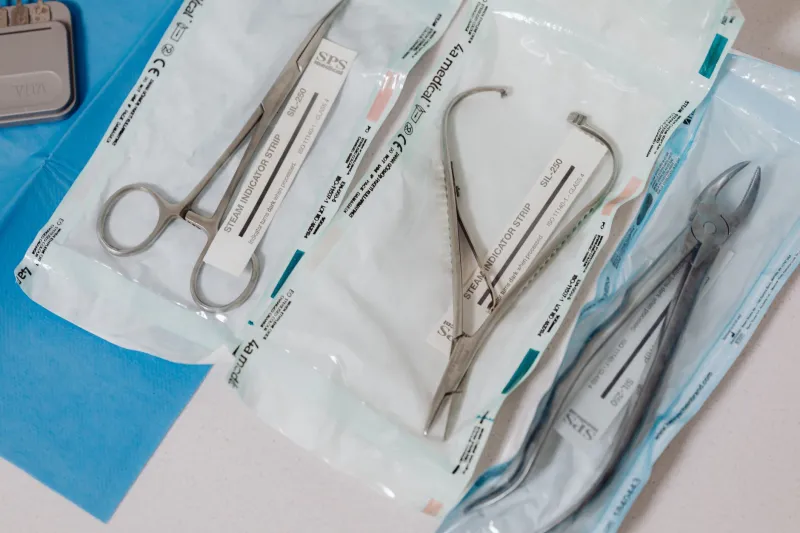
Not all sterilization methods are equivalent, and the appropriate method depends on the type of instrument being reprocessed. Steam sterilization (autoclaving) is the gold standard for heat-tolerant instruments. Low-temperature options such as ethylene oxide gas or hydrogen peroxide plasma sterilization are appropriate for heat-sensitive devices. High-level disinfection using liquid chemical agents is used for flexible endoscopes and similar equipment.
Asking this question communicates that you understand the difference — and that the facility should, too. A knowledgeable staff member should be able to explain the facility's sterilization protocols without hesitation.
4. How Are Instruments Tracked Through the Reprocessing Cycle?
Modern sterile processing relies on instrument tracking systems that use barcodes or RFID technology to document every stage of a tray's journey — from decontamination through sterilization to storage and final use. These systems create an auditable record that allows a facility to identify exactly which instruments were used in a given procedure and confirm that each underwent a complete, validated sterilization cycle.
Facilities still relying entirely on manual, paper-based documentation introduce unnecessary human error into a process where precision is non-negotiable.
5. What Is the Facility's Current Surgical Site Infection Rate?
Surgical site infection (SSI) rates are a direct reflection of a facility's infection control practices. Under the Centers for Medicare and Medicaid Services (CMS) quality reporting requirements, many facilities are required to report SSI data, and this information is often accessible through the CMS Care Compare tool or the facility's own quality reports.
 Photo: Centers for Medicare and Medicaid Services, via img.ricardostatic.ch
Asking for this data is not adversarial. It is exactly the kind of outcome-focused inquiry that high-performing facilities expect from engaged patients. A facility confident in its sterile standards will have this information readily available.
6. What Infection Control Protocols Are in Place Beyond Instrument Sterilization?
Sterile instruments are essential, but they are one component of a broader infection prevention framework. Ask about hand hygiene compliance monitoring, pre-operative patient skin preparation protocols, antibiotic prophylaxis practices, and environmental cleaning standards for procedure rooms. The CDC's Surgical Site Infection Prevention Guidelines and the Society for Healthcare Epidemiology of America (SHEA) provide evidence-based benchmarks that reputable facilities actively follow.
7. Are Single-Use Devices Disposed of After Each Patient?
Certain medical devices are manufactured and labeled for single-patient use only. Reusing these items — even after cleaning — is a violation of FDA regulations and a recognized infection risk. Patients are well within their rights to ask explicitly whether any single-use devices will be employed during their procedure and to confirm that these items are discarded after use, never reprocessed or shared between patients.
8. What Credentials and Continuing Education Requirements Apply to Clinical Staff?
Physician board certification and nursing licensure are familiar concepts to most patients, but the credentialing landscape for procedural facilities extends well beyond the clinicians in the room. Ask about the qualifications of surgical technologists, anesthesia providers (particularly whether a Certified Registered Nurse Anesthetist or anesthesiologist will be present), and the sterile processing team. Inquire whether the facility requires ongoing continuing education for clinical staff in areas such as infection control, sterile technique, and equipment handling.
9. How Does the Facility Handle a Potential Sterilization Failure?
Even in well-run facilities, sterilization equipment can malfunction. What matters is whether the facility has a documented, practiced protocol for identifying and responding to sterilization failures — including patient notification procedures, instrument quarantine processes, and root cause analysis requirements. A facility that has never considered this scenario is a facility that has not adequately prepared for it.
Ask directly: "If a sterilization failure were identified after my procedure, what steps would the facility take?" The quality of the answer will be telling.
10. Can I Review the Facility's Most Recent Inspection or Accreditation Survey Results?
Accreditation surveys and state health department inspections generate documented findings that reflect a facility's compliance with established standards. While not every detail of these reports is public, summaries are often available, and accredited facilities typically receive written reports from their accrediting bodies. Requesting access to recent survey outcomes — or asking whether any deficiencies were cited and how they were addressed — demonstrates the kind of engaged, outcome-focused inquiry that distinguishes a prepared patient from a passive one.
The Right Questions Lead to Better Outcomes
None of these questions are unreasonable. None of them should make a qualified, confident provider uncomfortable. In fact, the facilities most committed to sterile standards and precision care are precisely those that have already asked these questions of themselves — and built their protocols around the answers.
At SteriPuram, we believe that better outcomes begin with better conversations. Patients who arrive prepared, who understand what sterile standards mean and why they matter, and who hold their providers accountable to those standards are not difficult patients. They are the partners that high-quality medical care requires.
Before your next procedure, bring this list. Ask every question. And choose the facility whose answers give you confidence — not just convenience.