Two Words, One Critical Distinction: What Every Patient Must Understand About Clean Versus Sterile
Language matters in medicine. A misplaced decimal point on a prescription, a miscommunicated allergy, or a single ambiguous word in a surgical order can cascade into a life-altering event. Yet one of the most consequential vocabulary errors in healthcare is also among the most common — and it happens not only in hospital break rooms but at kitchen tables across America, wherever patients try to make sense of their care.
The words in question are clean and sterile. They sound like synonyms. In everyday conversation, they function as synonyms. In a clinical setting, they are separated by a gulf wide enough to allow dangerous pathogens to pass through.
What 'Clean' Actually Means in a Medical Context
In healthcare terminology, clean refers to the removal of visible debris, organic material, and a significant reduction in the overall number of microorganisms on a surface or instrument. Cleaning is accomplished through mechanical action — scrubbing, ultrasonic washing, enzymatic detergents — and it is absolutely essential. Without proper cleaning, sterilization itself becomes compromised, because organic matter can shield pathogens from sterilizing agents.
However, cleaning does not eliminate all microorganisms. Bacterial spores, certain viruses, and resilient pathogens may survive a cleaning process. A cleaned instrument is safer than an uncleaned one, but it is not safe for use in a procedure that breaches the body's natural defenses.
A clean environment, by extension, is one that has been sanitized to a level appropriate for general contact — the kind of standard you might apply to a countertop, a waiting room chair, or a nurse's workstation. Necessary? Absolutely. Sufficient for open surgery or catheter insertion? Categorically not.
What 'Sterile' Actually Means — And Why the Bar Is So Much Higher
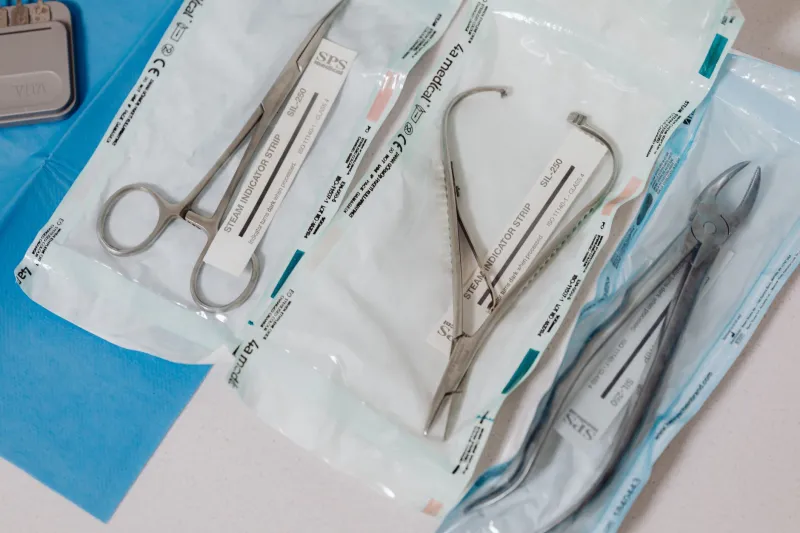
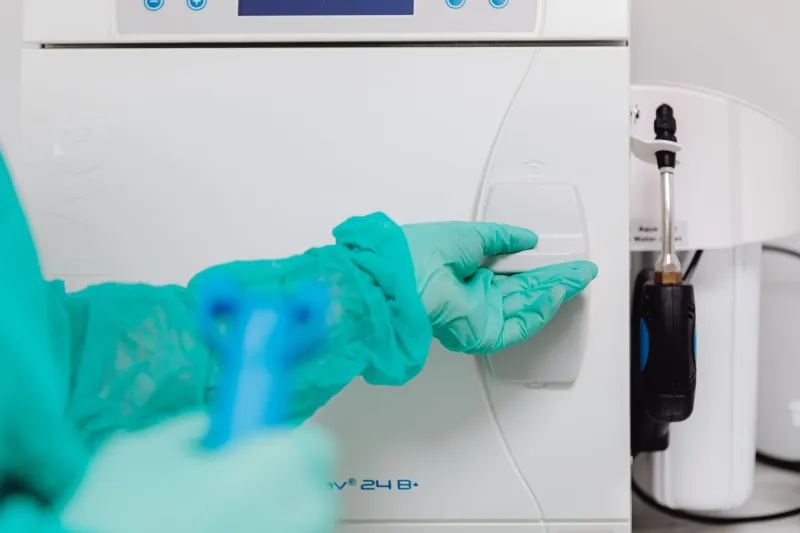
Sterility, in the medical and scientific sense, means the complete absence of all viable microorganisms, including bacterial spores. A sterile item or field has been processed in a manner — typically through autoclaving, ethylene oxide gas, gamma radiation, or hydrogen peroxide plasma — that destroys every living organism present.
The U.S. Food and Drug Administration and the Association for the Advancement of Medical Instrumentation (AAMI) define sterility in terms of a Sterility Assurance Level (SAL) of 10⁻⁶ — meaning there is no more than a one-in-one-million probability that a single viable microorganism remains on a processed item. That is not a marketing standard. It is an engineering and microbiological benchmark that demands rigorous process validation, equipment calibration, and continuous monitoring.
 Photo: U.S. Food and Drug Administration, via coloringcow.com
Sterile technique governs everything from how surgical instruments are packaged and stored to how a scrub technician's hands are positioned above a sterile drape. It is a system of interlocking disciplines, not a single act of washing.
When the Distinction Collapses: Real-World Consequences
The history of healthcare-associated infections (HAIs) in the United States is, in part, a history of the clean-versus-sterile confusion playing out in clinical practice.
Consider the documented outbreaks involving duodenoscopes — specialized endoscopic instruments used in procedures targeting the bile duct and pancreas. Investigations by the FDA and the Centers for Disease Control and Prevention (CDC) revealed that even facilities following manufacturer cleaning instructions were, in some cases, failing to achieve sterility in the instrument's complex, hard-to-reach channels. Patients contracted carbapenem-resistant Enterobacteriaceae (CRE), a class of bacteria that is nearly untreatable with standard antibiotics. The instruments had been cleaned. They had not been sterilized effectively. Patients died.
 Photo: Centers for Disease Control and Prevention, via drukatek.pl
On a less dramatic but equally instructive scale, studies have consistently demonstrated that improper hand hygiene — hands that are clean but not surgically sterile for invasive procedures — contributes meaningfully to surgical site infections (SSIs). The CDC estimates that SSIs affect approximately 160,000 to 300,000 patients in the United States each year, representing one of the most common and costly complications of inpatient surgical care.
These are not failures of intent. Many of the facilities involved had genuine commitments to patient safety. They were failures of precision — of not holding every procedural step to the correct standard for the level of risk involved.
How Sterility Is Maintained in a Rigorous Facility
A healthcare center that takes sterile standards seriously operates according to a set of interlocking systems that are visible, auditable, and continuously validated. Patients who know what to look for are far better positioned to evaluate the facilities they choose.
Sterile Processing Departments (SPDs) are the operational backbone of surgical sterility. In a well-run facility, the SPD functions as a controlled manufacturing environment — not a back-room cleaning station. Staff are credentialed through organizations such as the Certification Board for Sterile Processing and Distribution (CBSPD) or the Healthcare Sterile Processing Association (HSPA). Instruments are tracked through the entire reprocessing cycle using instrument management software, and biological indicators are run with every sterilization load to confirm efficacy.
Surgical suite design matters as well. Operating rooms in accredited facilities are built to maintain positive air pressure relative to adjacent corridors, filtered through HEPA systems, and temperature- and humidity-controlled. These environmental controls are not aesthetic choices — they are infection-control infrastructure.
Sterile field protocols govern every moment of a surgical procedure. Scrubbed personnel maintain specific postures, movement patterns, and spatial awareness relative to sterile drapes and instrument tables. A single breach — a non-sterile hand passing over a sterile field, a package opened incorrectly — requires immediate corrective action.
Supply chain integrity is a dimension patients rarely consider. Sterile supplies arrive in packaging with integrity indicators, and their sterility is only assured through a documented expiration date and an uncompromised package seal. A facility that stores supplies carelessly, allows packaging to be punctured, or uses expired materials has broken the sterile chain regardless of how rigorous its processing protocols may be.
Questions That Reveal Whether a Facility Understands the Difference
Armed with this knowledge, patients can ask more pointed questions before consenting to any invasive procedure. The answers — and the willingness of staff to engage with the questions — are themselves informative.
- Is your Sterile Processing Department staffed by certified technicians, and what credentialing body do they use?
- How does your facility track individual surgical instruments through the sterilization cycle?
- What biological and chemical indicator monitoring does your facility use to validate sterilization loads?
- Has your facility experienced any instrument-related infection events in the past three years, and how were they addressed?
- What accreditation body oversees your surgical services — The Joint Commission, DNV, or another recognized organization?
 Photo: The Joint Commission, via thumbs.dreamstime.com
A facility confident in its sterile standards will answer these questions without hesitation. Vague responses, deflection, or unfamiliarity with the terminology are warning signs worth heeding.
The Standard That Should Not Be Negotiable
At SteriPuram, the principle underlying every article and every clinical standard we examine is straightforward: patients deserve to understand the environment into which they are placing their trust. The clean-versus-sterile distinction is not a technicality for microbiologists. It is the line between a controlled, safe surgical environment and one where invisible threats retain the opportunity to cause harm.
The next time a healthcare provider, a facility brochure, or even a well-meaning family member assures you that a procedure will take place in a 'clean' environment, you are now equipped to ask the right follow-up question: clean by whose standard, and to what level of microbial control?
Precision in language reflects precision in practice. When the practice involves your body, that precision is not optional.