Cold Chain, Warm Risk: The Silent Threat of Temperature Failures in Hospital Biologics and Injectable Medications
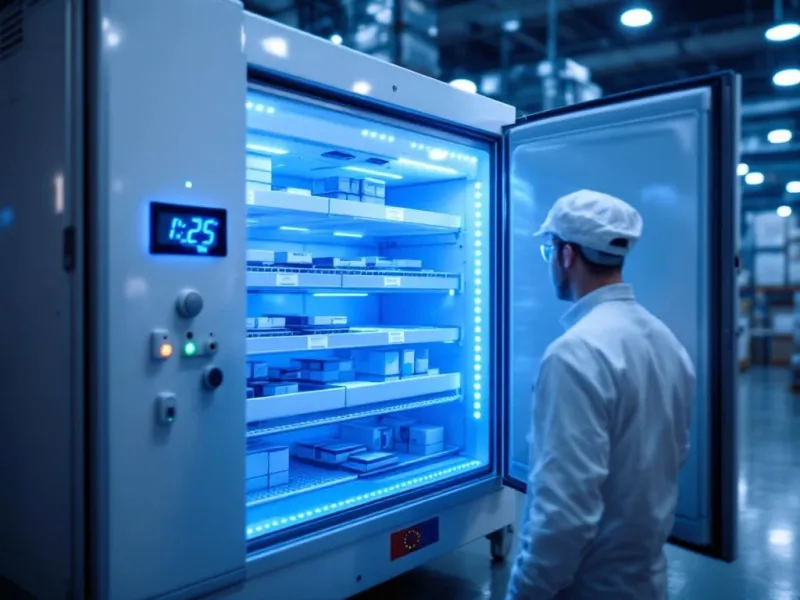
Photo: pharmaceutical cold chain refrigerator storage biologics temperature monitoring hospital, via www.senseanywhere.com
There is a particular category of medical risk that is almost entirely invisible at the point of care. It does not announce itself through a discolored vial, a cloudy solution, or an unusual odor. It arrives quietly, embedded in a product that looks exactly as it should, packaged correctly, labeled accurately, and administered by a clinician who has no reason to suspect that anything has gone wrong. The risk is temperature compromise — and for a growing class of temperature-sensitive medications, including biologics, monoclonal antibodies, vaccines, and sterile injectables, it represents one of the least-discussed vulnerabilities in the American healthcare supply chain.
Understanding cold chain failure requires stepping back from the clinical setting and following a medication's journey from the point of manufacture to the moment it enters a patient's body. That journey, often spanning thousands of miles and multiple custodial handoffs, is governed by a complex web of regulatory requirements, voluntary standards, and institutional practices — and it is more susceptible to breakdown than the healthcare system's public-facing communications typically acknowledge.
What the Cold Chain Actually Encompasses
The term "cold chain" refers to the temperature-controlled supply chain required to preserve the integrity of biological and pharmaceutical products from manufacturing through final administration. For most biologics and many sterile injectables, the required storage range is 2°C to 8°C (36°F to 46°F). Some products — certain vaccines, gene therapies, and cell-based treatments — require ultra-cold storage at temperatures as low as -80°C, a standard that became widely discussed during the distribution of mRNA COVID-19 vaccines but that has long applied to other advanced therapeutics.
A temperature excursion occurs any time a product is exposed to conditions outside its specified range, even briefly. The insidious quality of many excursions is their lack of visible consequence. A vial of a monoclonal antibody that spent four hours above its maximum temperature during a shipping delay does not change color. It does not precipitate. It does not develop particulate matter visible to the naked eye. It may, however, have undergone protein denaturation sufficient to meaningfully reduce its therapeutic efficacy — or, in some cases, to alter its immunogenic profile in ways that could produce adverse reactions in sensitive patients.
Where the Chain Is Most Likely to Break
Research into cold chain failures consistently identifies several high-risk points in the distribution pathway. Each represents a transition — a moment when custody of a temperature-sensitive product changes hands and the continuity of monitoring may lapse.
Manufacturing and initial distribution: Pharmaceutical manufacturers are subject to FDA Good Manufacturing Practice (GMP) regulations that include rigorous temperature controls. However, the transition from a manufacturer's climate-controlled warehouse to a third-party logistics provider introduces the first significant vulnerability. Ground and air freight carriers vary considerably in the quality of their cold chain infrastructure, and delays caused by weather, customs, or logistical disruptions can push products into non-compliant temperature ranges without triggering any immediate alert to the receiving facility.
Wholesale distribution: The wholesale pharmaceutical distribution tier — dominated by a small number of major distributors but also populated by dozens of smaller regional operators — is a critical link. The FDA's Drug Supply Chain Security Act (DSCSA) has strengthened traceability requirements in this sector, but temperature monitoring documentation requirements are not uniformly enforced across all product categories.
Hospital and clinic receiving and storage: Studies published in peer-reviewed pharmacy and nursing journals have repeatedly documented temperature excursions in hospital and clinic storage units. A 2019 analysis of vaccine storage practices across U.S. healthcare settings found that a substantial proportion of facilities had experienced refrigerator or freezer temperature excursions within the preceding year — many of which were not detected in real time. Power outages, equipment malfunctions, doors left ajar, and inadequate temperature monitoring technology all contribute to this pattern.
The last meter — preparation and administration: Even products that have been stored correctly can be compromised during preparation. Biologics drawn into syringes and allowed to sit at room temperature beyond recommended windows, injectables inadvertently exposed to light, or medications prepared in areas with inadequate temperature control represent the final category of cold chain risk — one that occurs entirely within the clinical environment.
The Regulatory Framework and Its Gaps
The FDA regulates the storage and handling of biologics and pharmaceutical products through a combination of GMP regulations, product-specific labeling requirements, and guidance documents. The U.S. Pharmacopeia (USP) provides detailed standards for pharmaceutical storage and transportation, including Chapter <1> and <1079>, the latter of which specifically addresses good storage and shipping practices.
Despite this regulatory architecture, oversight of cold chain compliance at the point of care — individual hospitals, infusion centers, and outpatient clinics — is largely delegated to state pharmacy boards and accreditation bodies such as The Joint Commission. The depth of scrutiny applied during accreditation surveys varies, and between surveys, the responsibility for maintaining cold chain integrity rests almost entirely with the facility's own pharmacy and nursing staff.
The practical consequence is that a patient receiving a biologic infusion for a chronic condition, or a vaccine at a community clinic, has no independent mechanism for verifying that the product they are about to receive has been maintained within its required temperature range throughout its entire journey. They are, by necessity, trusting a chain of custody they cannot observe.
How Hospitals and Infusion Centers Verify Product Integrity — and How They Don't
Best-practice pharmacy operations at well-resourced hospitals include continuous electronic temperature monitoring of all pharmaceutical storage units, documented excursion response protocols, and direct communication with distributors when shipments arrive with temperature data loggers showing out-of-range readings. Some facilities have invested in real-time monitoring platforms that alert pharmacy staff immediately when a storage unit deviates from its required range.
However, these practices are not universal. Smaller facilities, rural hospitals, and independent infusion centers may rely on twice-daily manual temperature checks — a protocol that can miss excursions occurring between readings. Temperature data loggers included in shipping containers are not always reviewed upon receipt, and when they are, the decision to accept or reject a product that shows a brief excursion is often made by staff without formal training in pharmaceutical stability assessment.
The burden of that decision matters enormously. A product accepted after an undocumented or inadequately evaluated excursion enters the patient care environment with a compromised but invisible integrity profile.
What Patients Should Know and Ask
For patients receiving high-cost biologics, immunotherapies, or other temperature-sensitive treatments, a few targeted questions can open a productive dialogue with their care team.
Ask your infusion center or pharmacy whether they use continuous electronic temperature monitoring for biological product storage. Ask whether they have a documented cold chain excursion policy and how products are assessed when a deviation is suspected. For patients self-administering injectable biologics at home — a common scenario for conditions such as rheumatoid arthritis, psoriasis, and multiple sclerosis — ask your specialty pharmacy for explicit guidance on home storage requirements and what to do if your home refrigerator malfunctions.
If you experience an unexpected lack of therapeutic response or an unusual reaction following a biologic administration, raise the possibility of product integrity compromise with your prescribing physician. It is a legitimate clinical consideration, and one that is more commonly overlooked than it should be.
Precision Care Requires an Unbroken Chain
At SteriPuram, the principle of sterile standards extends beyond the operating room to every point in the care continuum where product integrity can be compromised. Temperature management is sterility by another name — a discipline of preservation that protects patients not from microbial contamination, but from the subtler harm of receiving a medication that is no longer what it claims to be.
The cold chain is only as strong as its weakest custodian. Building a healthcare system that takes that reality seriously — and communicates it honestly to patients — is a necessary next step toward the better outcomes that precision care promises.