Midnight in the Sterile Processing Department: The After-Hours Vulnerability Window Your Hospital Won't Advertise
Midnight in the Sterile Processing Department: The After-Hours Vulnerability Window Your Hospital Won't Advertise
When patients prepare for surgery, their attention naturally gravitates toward the visible: the surgeon's board certifications, the hospital's U.S. News ranking, the anesthesiologist's bedside manner. What almost no one considers is what happened to their instruments at 3 a.m. — who cleaned them, who inspected them, and whether anyone was watching closely enough to catch a mistake.
The sterile processing department, or SPD, operates as the circulatory system of any surgical facility. Instruments flow in contaminated and must flow out verified sterile. It is painstaking, highly technical work. And on the overnight shift, it frequently occurs under conditions that infection control experts describe, in carefully measured language, as suboptimal.
What the Overnight Shift Actually Looks Like
Most major U.S. hospitals run surgical schedules that extend well into the evening. Emergency procedures, of course, recognize no schedule at all. The instruments used in a 9 p.m. appendectomy must be decontaminated, reassembled, inspected, packaged, and sterilized in time to be available for the morning's elective caseload — a window that can be as narrow as six to eight hours.
During the day, SPDs typically operate with full supervisory coverage, multiple technicians assigned to each processing station, and quality checks embedded at several points in the workflow. After midnight, the staffing picture changes dramatically. Accounts from certified sterile processing technicians across the country describe overnight departments running with as few as two or three staff members responsible for tasks that, during peak hours, might be distributed among ten or more.
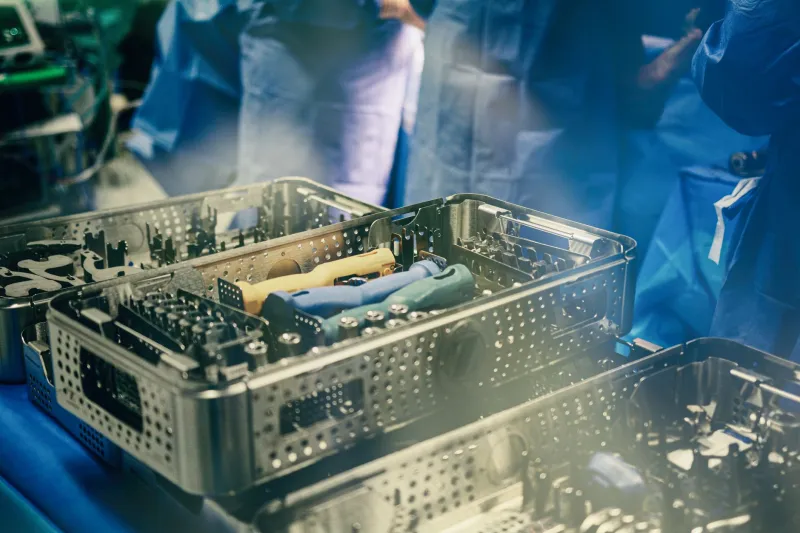
The math is unforgiving. A complex surgical tray — a major orthopedic or cardiovascular set, for instance — can contain more than 200 individual instruments. Each piece must be visually inspected for soil, damage, and proper function. Automated washers and sterilizers must be loaded correctly, with documentation at every stage. When a team of two is responsible for processing dozens of trays before 6 a.m., the pressure to move quickly is not a matter of attitude. It is arithmetic.
What Reduced Oversight Means in Practice
The Joint Commission, which accredits more than 22,000 healthcare organizations in the United States, has cited sterile processing deficiencies in hospital surveys with notable regularity. Among the most common findings: inadequate staff training, incomplete sterilization records, and failures in the verification steps that confirm instruments have reached appropriate sterilization parameters.
What the accreditation reports rarely capture is the temporal pattern of when these lapses are most likely to occur. Infection preventionists and SPD managers who have spoken publicly on the subject — including contributors to the Association for the Advancement of Medical Instrumentation's published guidance — consistently identify overnight and early-morning shifts as the periods of greatest vulnerability. Supervisors may be physically absent or available only by phone. Peer verification, in which one technician checks another's work, becomes difficult when staffing is thin. Fatigue compounds the problem: cognitive performance on tasks requiring sustained attention degrades measurably after midnight, a fact well-established in occupational health literature.
The consequences of a processing error are not always immediate or traceable. A surgical site infection that develops five days after a procedure is rarely connected, in the public record, to an improperly processed instrument tray assembled the night before. This disconnect between cause and effect is part of what keeps the overnight SPD out of the patient safety conversation.
The Compressed Timeline Problem
Beyond staffing ratios, the overnight shift contends with a structural pressure that daytime operations rarely face: the hard deadline of the morning's first case.
Elective surgical schedules at most U.S. hospitals begin between 7 and 7:30 a.m. Instruments must be available, verified, and delivered to the operating room before that time. If a complex instrument set arrives in the SPD at midnight — not an unusual scenario following an evening trauma case — the processing team has roughly six hours to complete a workflow that, done with full diligence, might take longer.
Some facilities respond to this pressure by maintaining larger instrument inventory, reducing the urgency of any single turnaround cycle. Others rely on loaner instrument sets from device manufacturers, which introduce their own sterility challenges, as SteriPuram has previously reported. But many hospitals, particularly those facing budget constraints or supply chain limitations, simply ask their overnight teams to work faster.
In sterile processing, speed and precision are not natural allies.
What Patients Can Reasonably Ask
For patients scheduled for elective procedures, particularly morning surgeries, there are questions worth raising — not to interrogate the facility, but to signal informed engagement and, in doing so, potentially prompt more careful practice.
Asking a facility how it manages instrument turnaround for instruments used in evening procedures is a legitimate inquiry. So is asking whether the SPD maintains consistent staffing ratios across all shifts, or whether supervisory coverage is present overnight. Facilities with robust sterile processing programs will typically have clear, confident answers. Vague or dismissive responses are themselves informative.
Patients undergoing procedures involving implants, complex instrumentation, or lengthy surgical times may wish to ask specifically whether any instruments in their procedure set were processed during an overnight cycle and what verification protocols apply in that context.
None of these questions are adversarial. They are the natural extension of the informed consent process — an acknowledgment that sterility is not a binary condition guaranteed by the presence of an autoclave, but a continuous outcome dependent on human performance, institutional systems, and the conditions under which both operate.
The Systemic Issue Behind the Overnight Risk
It would be reductive to frame the overnight SPD problem as a matter of individual technician performance. The certified sterile processing technicians who staff these shifts are, by and large, skilled professionals working within systems that undervalue and understaff their departments.
For decades, sterile processing was treated as a support function rather than a clinical one — a classification that influenced compensation, staffing models, and investment in training infrastructure. That perception has shifted in recent years, driven in part by high-profile infection outbreaks traced to processing failures and by advocacy from professional organizations representing SPD staff. Several states have moved to require certification for sterile processing technicians, a standard that was not uniformly enforced even a decade ago.
But systemic change is slow, and the overnight shift remains a structural weak point in the sterility chain that connects your surgeon's hands to the instruments they hold.
Precision Care Requires Round-the-Clock Commitment
At SteriPuram, our editorial commitment is to the proposition that precision care and sterile standards are not aspirational marketing language — they are operational requirements that must be met consistently, regardless of the hour. The overnight SPD shift is where that commitment is most severely tested and, too often, most quietly compromised.
Patients deserve to understand that the safety of their procedure is not determined solely in the operating room. It is determined in the hours before, in a department most patients will never see, by professionals whose work is rarely acknowledged and whose challenges are rarely disclosed. That knowledge is not cause for alarm. It is cause for engagement — with your facility, with your care team, and with the broader conversation about what genuine sterile standards require.