Precision Machines, Imperfect Protocols: The Sterilization Gaps Hiding Inside Robotic Surgery
The operating room has changed dramatically over the past two decades. Where a surgeon once stood directly over a patient, hand guiding a scalpel, today that same surgeon may be seated at a console across the room, navigating a robotic system whose slender arms and articulating instruments perform the physical work. Robotic-assisted surgery is now performed in hospitals across every U.S. state, with millions of procedures completed annually using platforms like the da Vinci Surgical System.
The clinical advantages are real. Smaller incisions, reduced blood loss, faster recovery times — the case for robotic surgery is well documented. But as these systems have proliferated, a quieter and more troubling question has emerged in sterile processing departments and infection control literature: are the instruments that make robotic surgery possible being cleaned and sterilized with the same rigor as conventional surgical tools? The honest answer, supported by a growing body of evidence, is that the gap between assumption and reality is wider than most patients are told.
Why Robotic Instruments Are Fundamentally Different to Reprocess
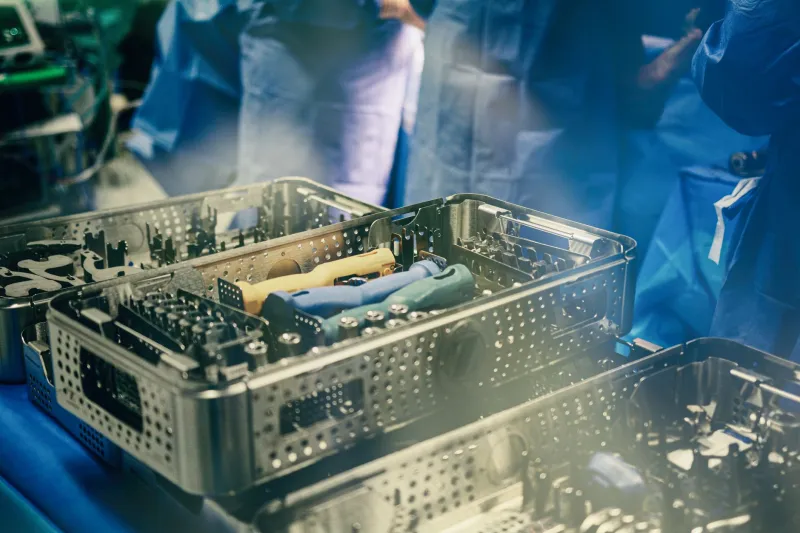
Conventional surgical instruments — forceps, retractors, clamps — are relatively straightforward to reprocess. They can be disassembled, manually cleaned, inspected under magnification, and run through validated sterilization cycles. Their geometry is simple enough that technicians can confirm, with reasonable confidence, that no organic material remains before sterilization begins.
Robotic instruments are architecturally different. The wristed end-effectors that give robotic systems their remarkable range of motion contain multiple articulating joints, small hinges, and narrow lumens through which irrigation fluid, tissue debris, and blood can travel during a procedure. Some instruments house internal cable-and-pulley mechanisms that create spaces inaccessible to standard brushes or flushing equipment. After a procedure, these internal pathways may retain biological material that, if not completely removed, will not be reliably eliminated during sterilization — because sterilization kills microorganisms but does not dissolve organic matter that shields them.
This is not a theoretical concern. Peer-reviewed studies and reports submitted to the FDA's MAUDE database have documented cases where robotic instruments were returned for reprocessing with visible contamination in internal channels, and where post-sterilization inspection revealed residual soil. The challenge is compounded by the fact that the instruments themselves signal when they have reached their maximum use count — not necessarily when they are too contaminated to clean safely.
The Proprietary Problem
One of the most underappreciated obstacles to rigorous robotic instrument sterilization is the proprietary nature of these systems. Manufacturers like Intuitive Surgical provide detailed Instructions for Use (IFU) that specify exactly how their instruments must be cleaned and sterilized. Hospitals are contractually and legally bound to follow these instructions; deviating from them can void warranties, trigger regulatory scrutiny, and expose facilities to liability.
On the surface, this sounds like a patient safety measure. In practice, it creates complications. IFUs for robotic instruments are frequently lengthy, technically demanding, and require specialized equipment that not every sterile processing department possesses. Staff must be trained specifically on these documents, and that training must be refreshed as instrument designs evolve. When a hospital is operating multiple robotic platforms from different manufacturers — each with its own IFU — the cognitive and logistical burden on reprocessing personnel becomes substantial.
Critically, some researchers and sterile processing professionals have questioned whether manufacturer-provided IFUs are sufficiently validated under real-world conditions. Laboratory validation studies submitted for regulatory clearance do not always replicate the volume, pace, and resource constraints of a busy hospital's sterile processing department. The protocol that works cleanly in a controlled setting may be difficult to execute consistently at 11 p.m. on a Friday when the next morning's surgical schedule is already loading instruments back onto the line.
Standardization Remains an Unfinished Project
For conventional surgical instrument reprocessing, the U.S. healthcare system has developed robust standards over decades. Organizations including AAMI, AORN, and The Joint Commission have established guidelines that, while not perfect, provide a consistent framework across facilities.
Robotic instrument reprocessing lacks equivalent universal standardization. Guidance exists, but it is fragmented — spread across manufacturer IFUs, professional society recommendations, and facility-specific policies that vary considerably from one hospital to the next. A patient undergoing a robotic prostatectomy at a large academic medical center in Boston may be exposed to a meaningfully different reprocessing protocol than a patient having the same procedure at a community hospital in rural Tennessee. Neither patient is typically aware of this variability, nor are they routinely given the opportunity to ask about it.
The Association for the Advancement of Medical Instrumentation has called for more rigorous, standardized approaches to complex instrument reprocessing, and individual researchers have published recommendations for improving robotic instrument cleaning validation. Progress is occurring, but it is incremental — and the pace of technological adoption in robotic surgery has consistently outrun the development of the supporting safety infrastructure.
What Patients Should Ask Before Consenting
None of this is intended to discourage patients from pursuing robotic surgery when it represents the clinically appropriate choice. The goal, consistent with the standards SteriPuram holds for all of its editorial content, is to ensure that patients enter these decisions with accurate information rather than a passive assumption that sophisticated technology equals comprehensive safety.
Before consenting to a robotic procedure, patients are well within their rights to ask the following questions directly of their surgical team or the facility's patient services staff:
How are robotic instruments reprocessed at this facility? Ask whether the hospital follows manufacturer IFUs precisely and whether those protocols have been reviewed by an independent sterile processing expert or infection preventionist.
What training does sterile processing staff receive specifically for robotic instruments? Competency in conventional instrument reprocessing does not automatically transfer. Dedicated, documented training matters.
Has this facility had any documented infections or adverse events associated with robotic instrument reprocessing? Facilities are not always forthcoming with this information, but asking signals that you are an engaged, informed patient — and may prompt more candid responses.
How does the facility track instrument use counts and inspection findings? Robust tracking systems that flag instruments approaching end-of-life or showing signs of incomplete cleaning are a marker of a mature sterile processing program.
Is there an infection preventionist involved in oversight of the robotic surgery program? Infection prevention expertise should extend beyond the operating room itself and encompass the entire instrument lifecycle.
The Standard Must Match the Technology
Robotic surgery represents one of the most significant advances in procedural medicine in a generation. The precision it offers is genuine, and for many patients, it delivers meaningfully better outcomes. But precision in the operating room is only as meaningful as the sterility of the instruments being used. A robotic arm that functions with sub-millimeter accuracy inside a patient's body is simultaneously capable of transmitting infection if the instrument it carries was not reprocessed correctly.
The sterility standards that govern these extraordinary machines must be as rigorous, as validated, and as consistently applied as the surgical techniques they enable. Until universal, evidence-based reprocessing standards for robotic instruments are established and enforced across all U.S. facilities, patients have both the right and the responsibility to ask hard questions — and to expect clear, honest answers.