Twelve Hands, One Scalpel: The Rigorous Path a Surgical Instrument Travels Between Patients
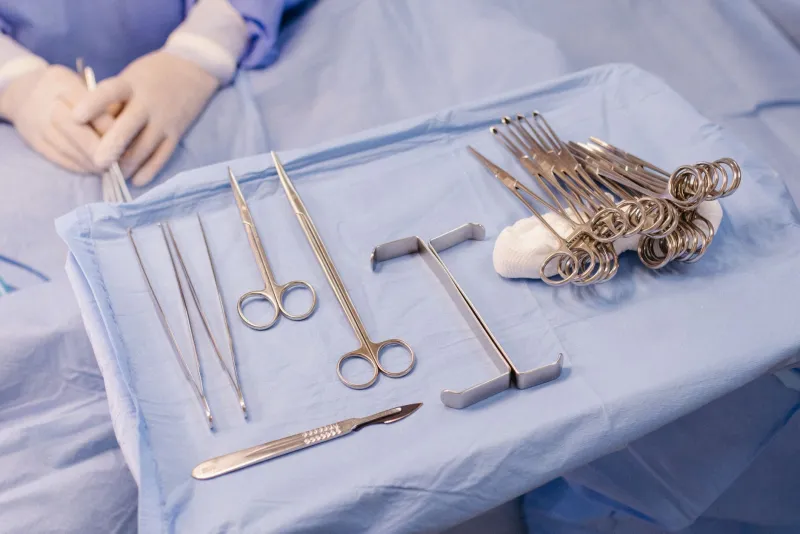
When a surgeon sets down a retractor at the conclusion of a procedure, that instrument does not simply get rinsed off and placed back on a tray. What follows is a carefully choreographed sequence of events — governed by federal guidelines, manufacturer specifications, and institutional protocols — that can span several hours and involve a dozen or more trained personnel before that same tool is deemed safe for the next patient. For most Americans undergoing surgery, this behind-the-scenes process is entirely invisible. It should not be.
At SteriPuram, we believe that informed patients make better decisions about where they receive care. And few aspects of surgical safety are as consequential — or as misunderstood — as the lifecycle of a reusable surgical instrument.
The Moment After Surgery: Contamination Begins at the Field
The moment an instrument contacts blood, tissue, or bodily fluids, it is classified as contaminated. At the close of every surgical procedure, circulating nurses and scrub technicians work together to account for every item on the sterile field — a process called the instrument count. Nothing leaves the operating room untracked.
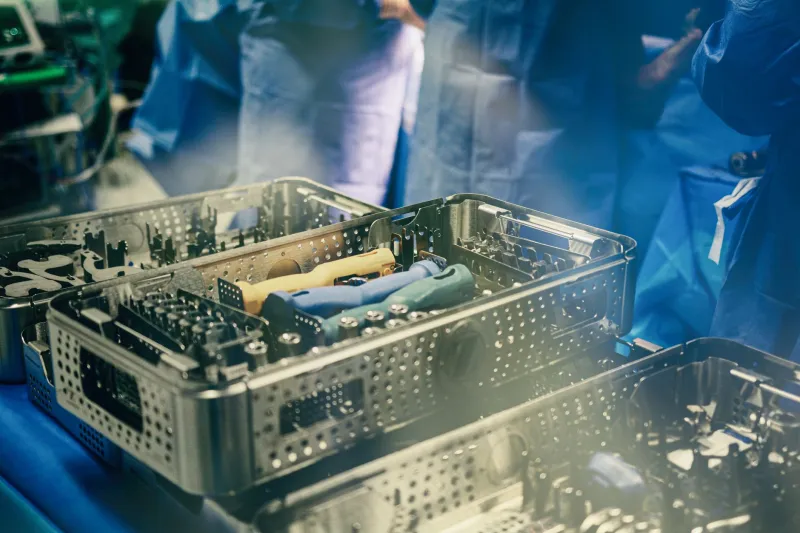
Contaminated instruments are carefully placed into rigid transport containers or puncture-resistant trays, often pre-treated with an enzymatic foam or gel spray. This pre-treatment step matters enormously: organic material that dries and hardens onto metal surfaces becomes exponentially more difficult to remove, and any residual bioburden can compromise the sterilization process downstream. Time is already a factor before the instruments have even left the room.
Receiving and Sorting in the Decontamination Zone
Instruments arrive at the Sterile Processing Department (SPD) — sometimes called Central Sterile Supply or CSS — where technicians working in a physically separated decontamination zone receive them. This area operates under negative air pressure relative to the rest of the department, a design feature that prevents airborne contaminants from migrating into clean spaces.
Here, technicians sort instruments by type, manufacturer, and material. Delicate optics are separated from heavy retractors. Instruments with lumens — hollow channels, such as those found in laparoscopic tools — require specialized cleaning protocols that differ significantly from those applied to solid-surface instruments. A technician who conflates the two categories is not cutting corners; they are potentially endangering a future patient.
Mechanical and Manual Cleaning: Where Precision Meets Chemistry
Most instruments enter an automated washer-disinfector, a machine that subjects them to high-temperature water jets combined with enzymatic detergents specifically formulated to break down proteins, fats, and carbohydrates left behind by surgical procedures. Cycles are validated and logged, and temperature parameters are monitored in real time.
However, automation has its limits. Instruments with complex hinges, serrated edges, box locks, or intricate internal channels often require manual brushing under running water before they enter any machine. Technicians use brushes sized to the specific instrument, working under magnification in some facilities to ensure that every crevice is addressed. This is skilled labor — not a task that can be rushed without consequence.
Following the wash cycle, instruments pass through a thermal disinfection phase, reaching temperatures sufficient to reduce microbial load to a safe threshold. They emerge hot and must be handled with care to avoid both burns and recontamination.
Inspection: The Step That Catches What Machines Cannot
Clean instruments move into the preparation and packaging area, where the work shifts from chemistry to human judgment. Technicians inspect every item under magnification and bright lighting, evaluating for:
- Residual soil — any visible debris that survived the cleaning cycle
- Corrosion or pitting — surface damage that can harbor microorganisms even after sterilization
- Functional integrity — do the jaws of a hemostat align properly? Does a needle driver's ratchet lock at each position without slipping?
- Sharpness — a dull scalpel or scissors blade is both a patient safety issue and a sign of instrument wear
Instruments that fail inspection are pulled from circulation for repair or disposal. Those that pass are lubricated where appropriate, reassembled, and organized into procedure-specific trays according to preference cards that reflect each surgeon's requirements.
Packaging: Creating the Sterile Barrier
Before an instrument or tray can be sterilized, it must be packaged in a way that will maintain sterility from the moment sterilization is complete until the moment a scrub technician opens it in the operating room. This is not incidental wrapping — it is a validated sterile barrier system.
Facilities use a combination of rigid sterilization containers, peel pouches, and woven or non-woven wraps, each of which must be appropriate for the sterilization method being used. Steam sterilization, the most common method in U.S. hospitals, requires packaging that allows steam penetration while preventing post-cycle contamination. Every package receives a chemical indicator — a small strip or label that changes color when exposed to the correct sterilization conditions — and is labeled with the sterilizer load number, the date of sterilization, and an expiration date.
Those labels are not bureaucratic formality. They are the chain of custody.
The Sterilizer: Validated, Monitored, and Never Assumed
Packed trays enter a steam autoclave, where they are exposed to saturated steam at temperatures typically between 270°F and 275°F (132°C–135°C) under pressure. The cycle includes a conditioning phase, an exposure phase timed to the load configuration, and a drying phase. Every parameter is recorded automatically.
But temperature and time alone are not sufficient verification. Facilities run biological indicators — vials containing highly resistant bacterial spores — with every load or at scheduled intervals. If those spores are killed, the sterilization cycle is confirmed effective. If they survive, the entire load is recalled and every instrument is reprocessed. No exceptions.
The Association for the Advancement of Medical Instrumentation (AAMI) and The Joint Commission both establish standards governing sterilizer validation, and accredited U.S. facilities are subject to audit against those benchmarks.
Storage and Delivery: Maintaining What Was Earned
Sterile packages are transported to climate-controlled storage areas where temperature and humidity are maintained within defined ranges. Packages are stored off the floor, away from moisture sources, and organized to ensure that older items are used before newer ones — a practice known as event-related sterility management.
When a procedure is scheduled, the appropriate tray is retrieved, its integrity is visually confirmed, and it is transported to the operating room in a manner that protects the sterile barrier. Only at the moment a credentialed scrub technician opens the package at the sterile field — checking the chemical indicator one final time — does the instrument complete its journey.
Why Every Link in This Chain Matters
The lifecycle described above is not theoretical. It is the standard against which accredited U.S. surgical facilities are measured, and it represents the accumulated knowledge of decades of infection control research. Surgical site infections (SSIs) remain one of the most common and costly healthcare-associated infections in the country, with the Centers for Disease Control and Prevention estimating hundreds of thousands of cases annually.
When any single step in this chain is abbreviated — whether due to staffing shortages, equipment failures, inadequate training, or institutional pressure to turn over rooms quickly — the risk to the next patient increases. A missed soil deposit. An improperly validated cycle. A package stored in a humid corridor. Each represents a point at which the standard was not met.
Patients have every right to ask their surgical facility how instruments are processed, who performs that work, and how the department is staffed and accredited. The answer to those questions says a great deal about the culture of safety within that institution.
At SteriPuram, our commitment to sterile standards is not a tagline — it is the foundation upon which every patient outcome rests. The journey of a single instrument, handled correctly by skilled professionals at every stage, is one of the most powerful expressions of that commitment.