What Happens in the Hour Before Your Surgery: A Patient's Guide to Pre-Procedure Sterility Protocols
What Happens in the Hour Before Your Surgery: A Patient's Guide to Pre-Procedure Sterility Protocols
For most Americans preparing for a surgical procedure, the mental checklist looks familiar: confirm the surgeon's board certifications, review the anesthesia plan, arrange transportation home, and fast after midnight. These are reasonable priorities. Yet an entirely separate checklist — one far more elaborate and far less visible — is already underway in the operating room suite hours before a patient is ever wheeled through the door.
At SteriPuram, our editorial mission is rooted in one conviction: informed patients are safer patients. With that in mind, this article offers a detailed, plain-language account of the pre-surgical sterility protocols that govern modern operating rooms across the United States. Understanding these measures will not only give you a deeper appreciation for what "surgical readiness" genuinely entails — it may also help you ask sharper questions when evaluating any facility where you plan to receive care.
The Operating Room Is Never Simply "Empty"
Between procedures, an operating room is not merely vacated and left to sit idle. Accreditation standards set by organizations such as The Joint Commission and guidelines from the Association of periOperative Registered Nurses (AORN) require that the environment undergo structured decontamination after every case. Surfaces — including the operating table, overhead lights, equipment arms, and floor — are wiped down with EPA-registered, hospital-grade disinfectants. High-touch areas receive particular attention.
Once terminal cleaning is complete, the room enters what some facilities describe as a "recovery period" before the next case begins. This interval allows the ventilation system to complete the required number of air exchanges — typically a minimum of 15 air changes per hour in an OR, with at least three of those changes involving outside air. These exchanges are not incidental; they are engineered to dilute and remove airborne particulates, including microorganisms that can compromise a sterile field.
Positive-pressure air systems, which push filtered air outward from the OR rather than drawing potentially contaminated corridor air inward, are a standard architectural feature in most accredited surgical facilities. High-efficiency particulate air (HEPA) filtration is the benchmark, capable of capturing 99.97 percent of particles as small as 0.3 microns.
Surface Decontamination: More Than a Wipe-Down
The term "decontamination" understates the deliberateness of what actually occurs. Perioperative staff follow scripted protocols that define which products are used, how long they must remain wet on a surface (known as the contact or "dwell" time), and in what sequence surfaces are addressed. Skipping a surface or shortening the dwell time — even inadvertently — can leave viable pathogens behind.
For procedures carrying elevated infection risk, some facilities supplement standard chemical disinfection with ultraviolet-C (UV-C) light devices, which are deployed in the room after manual cleaning to provide an additional layer of pathogen reduction. While UV-C technology is not yet universal, its adoption in U.S. surgical centers has grown meaningfully over the past decade.
Equipment brought into the room — anesthesia machines, monitoring carts, electrosurgical units — undergoes its own surface disinfection protocol before each case. Nothing enters the sterile environment without having been assessed.
Instrument Sterilization: A Process That Began Hours Earlier
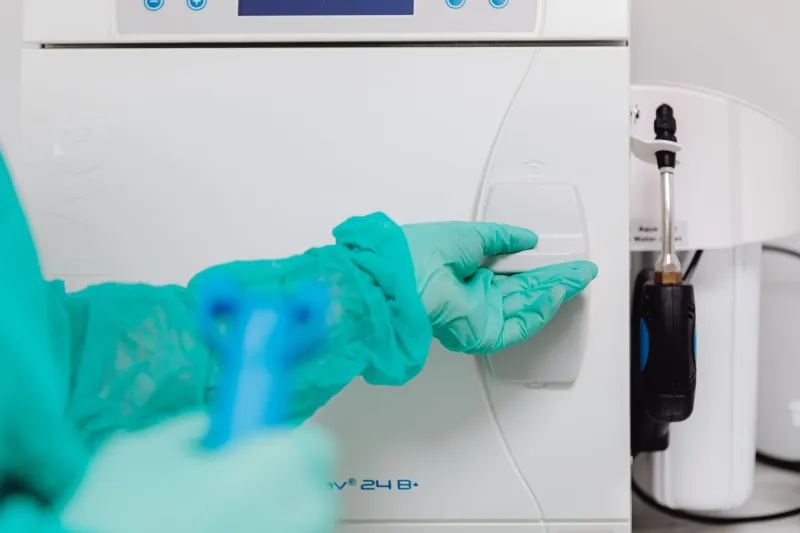
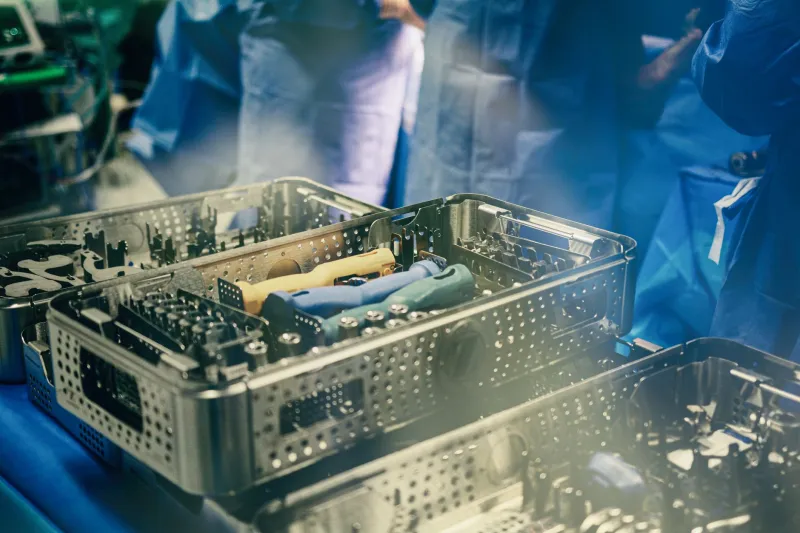
By the time the surgical team assembles in the OR, the instruments they will use have already completed a lengthy journey through the Sterile Processing Department (SPD). That journey typically involves manual cleaning, ultrasonic cleaning, inspection, assembly into trays, and sterilization — most commonly via steam under pressure in an autoclave, though hydrogen peroxide gas plasma is used for heat-sensitive instruments.
Critically, each instrument tray is sealed in sterilization pouches or wrapped in barrier materials, then tagged with a chemical indicator that changes color when the correct sterilization parameters have been achieved. A second indicator — a biological indicator using live bacterial spores — is periodically run to confirm that the sterilizer itself is functioning properly. These are not optional quality checks; they are required components of a compliant sterile processing program.
Once sterilized, trays are transported to the OR in enclosed, protected carts and stored in dedicated sterile supply areas. Handling protocols minimize the risk of contamination between the SPD and the surgical field.
The Sterile Field: Assembly Under Strict Conditions
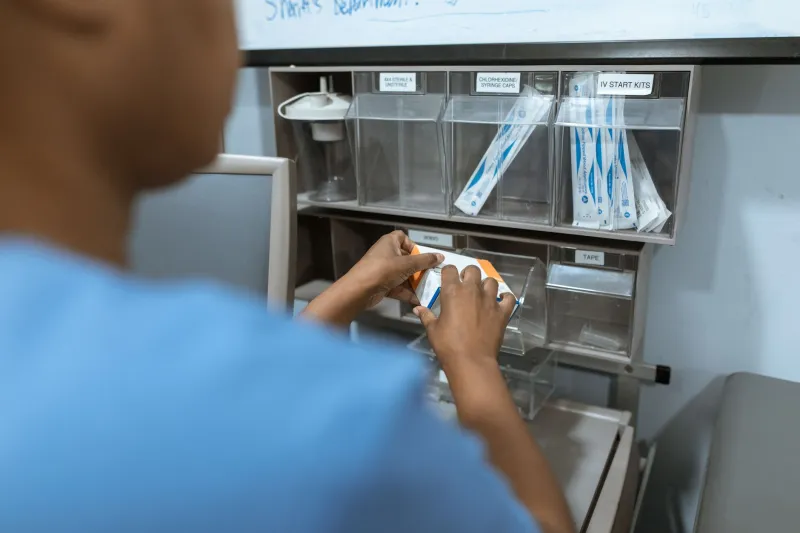
Approximately 30 to 60 minutes before a scheduled procedure, the scrub technician or scrub nurse begins setting up the sterile field. This involves opening sterilized instrument packages using a technique designed to prevent the inner sterile surface from contacting any non-sterile material, arranging instruments on a draped back table, and verifying that every item required for the case is present and accounted for.
The instrument count — performed jointly by the scrub and circulating nurses — is among the most consequential steps in pre-surgical preparation. Every sponge, needle, and instrument is counted aloud and documented before the procedure begins. This baseline count will be reconciled again before the surgical site is closed, and once more at the conclusion of the case. The goal is unambiguous: no retained surgical item.
Once the sterile field is established, it is treated as inviolable. No one reaches across it without a sterile gown and gloves. Traffic through the OR is restricted. Doors remain closed to preserve air pressure differentials. Even conversation near an open sterile field is managed carefully, as respiratory droplets represent a contamination vector.
What This Means for You as a Patient
Understanding the depth of pre-surgical preparation carries practical value for patients. When touring a surgical facility or asking questions during a pre-operative consultation, you are now equipped to inquire about specifics: Does the facility use HEPA filtration in its operating rooms? What is the standard air exchange rate? How does the SPD document sterilization compliance? Are biological indicators used on a routine schedule?
Facilities that welcome these questions — and answer them with transparency — are demonstrating a culture of accountability. Those that deflect or minimize should prompt further scrutiny.
It is also worth recognizing that the protocols described above represent the standard, not the exceptional. Accredited surgical centers in the United States are expected to meet these benchmarks consistently, across every case, every day. When a facility describes itself as committed to sterile standards, these are the specific practices that commitment must encompass.
Precision Care Begins Long Before the Incision
Surgery is often framed as a singular event — the procedure itself. In reality, a successful surgical outcome is the product of an extended sequence of controlled actions, each one designed to reduce risk and preserve the integrity of the environment in which care is delivered.
The operating room you enter has been cleaned, monitored, filtered, and stocked according to protocols refined over decades of evidence-based practice. The instruments placed in your surgeon's hands have passed through multiple verification steps before reaching the sterile field. The team surrounding you has followed a structured choreography of preparation that began hours before your arrival.
At SteriPuram, we believe that patients who understand this process are better positioned to advocate for themselves, evaluate their options thoughtfully, and approach their care with well-founded confidence. Sterility is not a background detail — it is the foundation upon which every safe surgical outcome is built.